
Four clicks
Find the listener you are
Question 1 of 4
What do you notice first in a song?
A headphone advert might promise a 50 mm driver, a titanium diaphragm, and studio-quality sound. Those words do not tell you what your favourite song will sound like.
Will the bass feel powerful? Will the singer sit close and clear? Will the cymbals sparkle, or wear you out after twenty minutes?
Buying gets easier once two ideas are separate.
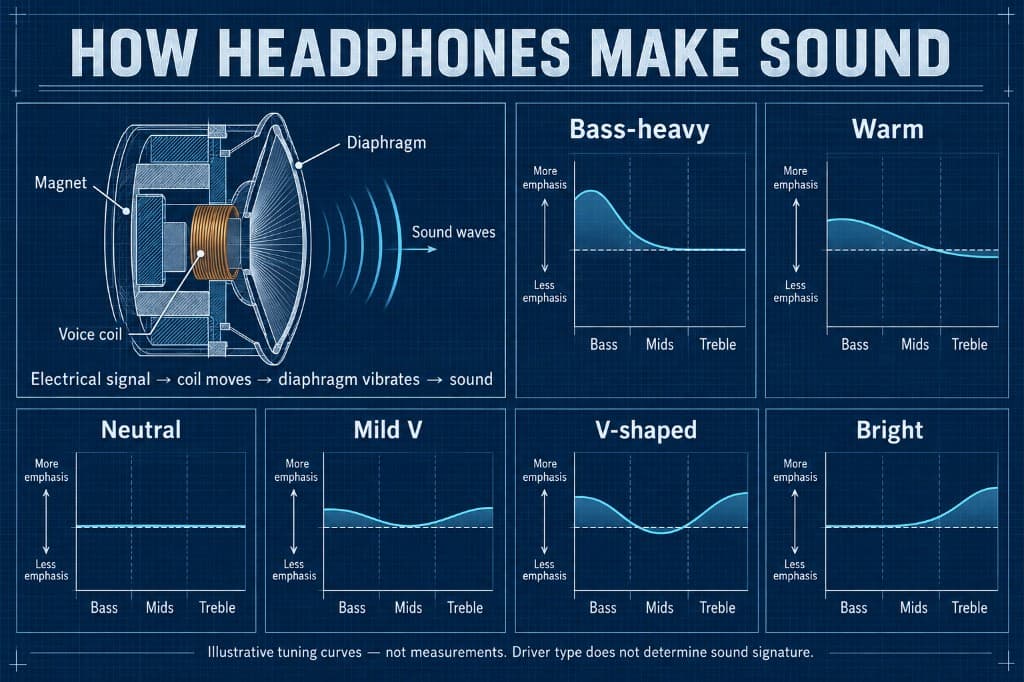
The driver makes the sound. The tuning shapes its balance.
The chart under the title is a picture of both ideas. The left side is the driver. The curves are simplified examples of tuning, not measurements of any headphone on this page. A driver type does not decide the sound signature.
What a headphone driver is
A headphone driver is the small assembly inside each earcup that turns an electrical signal into moving air. Think of a tiny loudspeaker sitting next to your ear.
A normal pair of stereo headphones has one full-range driver on each side. That one driver can make bass, mids, and treble. Some designs split the work across several drivers.
The driver is more than the thin surface you sometimes see behind a grille. It is the parts that move together.
Bass, mids, and treble
Music holds many frequencies at once. Frequency is how fast something vibrates, measured in hertz (Hz). Slow vibrations are low notes. Fast vibrations are high notes.
These ranges are approximate. Audio people do not all use the same cutoffs.
| Region | Approximate range | What you hear |
|---|---|---|
| Sub-bass | 20–60 Hz | Deep electronic rumble and the lowest bass notes |
| Bass | 60–250 Hz | Kick-drum weight, bass-guitar body, and punch |
| Midrange | 250 Hz–2 kHz | Much of the body of voices, guitars, and piano |
| Upper mids | 2–4 kHz | Vocal presence, articulation, and bite |
| Treble | 4–20 kHz | Cymbal shimmer, consonants, brightness, and air |
A voice is not only “the mids.” It also has low-frequency body and higher harmonics. That is why a treble change can change how a singer sounds.
Ask a simpler question before you shop: do you want more rumble, more punch, clearer vocals, or more sparkle? Those are different requests.
How a dynamic driver works
Dynamic drivers, also called moving-coil drivers, are the ones you will see most often.
Three parts do the work:
- The magnet makes a magnetic field.
- The voice coil is a coil of wire attached to the diaphragm.
- The diaphragm is the thin surface that moves the air.
When you press play:
- The audio signal flows through the voice coil.
- That current pushes against the magnet’s field.
- The coil moves, and the diaphragm moves with it.
- The moving diaphragm changes the air pressure.
- Your ear reads those changes as sound.
The diaphragm does not make one shake for bass and another for vocals. One movement carries the whole recording.
Dynamic and planar drivers both use magnets. They apply the force in different ways. Audeze’s note on driver construction is a useful contrast.
Headphones.com’s short film shows the same idea, then the other driver types, in a few minutes.
Dynamic does not mean bassy
A dynamic driver can be tuned bass-heavy, neutral, warm, or bright.
The V-MODA M-100 PRO is a closed DJ pair built around the beat. Sennheiser builds the HD 560S around a more even balance. Same driver family. Different sound. Both are on Headphone Zone, and both are under ₹30,000.
A bigger driver is not a better driver
A larger diaphragm can move more air. Diameter alone does not tell you the bass is deeper, the distortion is lower, or the tuning is better.
A careful small driver can beat a careless large one. Treat “40 mm,” “50 mm,” or “60 mm” as a construction detail, not a score.
Other driver types
These are different ways to move air. They are not a ladder from beginner to expert.
| Driver | How it works | What to remember |
|---|---|---|
| Dynamic | A moving coil drives a diaphragm in a magnetic field. | Common at every price. It can be tuned many ways. |
| Planar magnetic | Traces on a thin sheet interact with magnets, so the force is spread across the surface. | Can stay clean and take EQ well. Weight and power needs depend on the model. |
| Balanced armature | A tiny armature moves and pushes a diaphragm through a link. | Common in earphones. Small enough that several can share one ear. |
| Electrostatic | A charged sheet moves between electrodes. | Full-size pairs usually need a matching energizer or amplifier. |
| Piezoelectric MEMS | Microscopic parts move by a piezoelectric effect. | Used in some newer earphones and hybrids. The finished tuning matters more than the novelty. |
Maker notes, if you want the mechanism in their words: planar diaphragms, balanced armatures, electrostatic headphones, and piezoelectric MEMS.
A driver technology can make a design goal easier. It does not promise the sound you want.
What triple-driver means
A multi-driver headphone splits the frequency range across more than one unit. A crossover decides which driver gets which part of the signal. That split can be electrical, digital, acoustic, or a mix.
Nothing’s Headphone (1) Pro lists three:
- A 40 mm dynamic driver for bass
- A 13 × 8 mm dynamic driver
- An xMEMS driver for treble
The product page says they handle different parts of the range, and the app can still EQ the result.
Splitting the work can give a designer more control. The drivers still have to blend. A rough join can leave a dip or a bump where they meet.
Three drivers do not automatically beat one. Listen for one coherent sound at the volume you actually use.
Sound signatures, in everyday words
A sound signature is the balance of bass, mids, and treble. Same song, different seasoning.
These names are shorthand. There is no meter that officially makes a headphone “warm” or “Mild V.” Two shops can describe one model differently. Two listeners can hear it differently.
| What you enjoy | Signature to try | A common name for the listener |
|---|---|---|
| Deep rumble and strong beats | Bass-heavy | Basshead |
| Full voices and gentle highs | Warm | Warm-sound listener |
| A fairly even balance | Neutral | Reference listener |
| A little extra energy, vocals still present | Mild V | No settled nickname |
| Strong bass and lively highs | V-shaped | Often called a “fun” tuning |
| Sparkling cymbals and prominent highs | Bright | Treble enthusiast |
| The singer and lead instruments up front | Mid-focused | Vocal lover |
| Softer highs | Dark | Treble-sensitive listener |
“Basshead” is a preference. “Audiophile” only means someone who cares how sound is reproduced. An audiophile can like any row in that table.
Bass-heavy
If the beat is what pulls you in, start here. There are two kinds of bass satisfaction. Sub-bass is the deep rumble. Mid-bass is the punch of a kick and the body of a bass line. You may want one more than the other.
Listen for bass that reaches low, stays separate from the next note, and still leaves the words clear. A poor seal from glasses, hair, or loose pads can take the bass away before the driver gets a chance.
The V-MODA M-100 PRO is a place to start on Headphone Zone if you want the beat on purpose. It is a closed pair, listed under ₹30,000. In a shop, play a bass-heavy track that also has a singer. Can you enjoy the beat and still follow the words?
Warm
Warm usually means extra bass or lower-mid body, and sometimes gentler highs. It can suit acoustic music, soul, jazz, or any record you want to hear without an edge. Genre is a hint, not a rule.
Voices should sound rich, not muffled. Piano and guitar should keep their body and still stay distinct.
The Sennheiser HD 650 is the pair to audition. Headphone Zone lists it under ₹30,000 and files it as warm and smooth. It is an open-back wired headphone, so it belongs in a quiet room. Warmth should invite you in, not hide the song under a blanket.
Neutral
Neutral means no obvious exaggeration against a chosen listening target. It does not mean “no bass.” The bass should support the music instead of covering it.
This balance suits people who jump between genres, and people who edit audio, as long as they know the headphone and check the work on other speakers.
The Sennheiser HD 560S is a clear starting point on Headphone Zone, under ₹30,000. It is open-back, so it is a poor choice for a train. If you are used to boosted bass, a neutral pair can sound thin on the first day. Give it a few songs before you decide.
Mild V
A mild V lifts bass and treble a little, and leaves the middle closer than a strong V. You get some punch and some sparkle, and the singer does not step as far back.
When the drums, guitars, and cymbals all arrive, the voice should still be easy to follow. Stay with it long enough to learn whether the treble stays comfortable.
Headphone Zone lists the FiiO FT1 as Mild V, and the pair is under ₹30,000. FiiO specifies a closed-back design and a 60 mm dynamic driver. That millimetre size is construction. Mild V is the tuning. Your ears decide whether this particular balance fits.
V-shaped
A stronger V pushes bass and treble up and lets the middle sit further back. It can feel exciting. Vocals may sound further away than on a mid-focused pair. The sound that impresses you in thirty seconds can tire you over an album. Listen to vocal distance and cymbal sharpness.
The Audio-Technica ATH-M50x is a lively closed pair on Headphone Zone, under ₹30,000. Headphone Zone notes that it carries more low-end weight than a flat studio headphone. Listen for whether the singer sits back, and whether the bright sounds stay comfortable.
Bright
Bright headphones give the upper frequencies more prominence. Cymbals, guitar attack, and small sounds in the recording stand out. Some people love that. Others find it tiring.
More treble is not automatically more detail. Making a sound louder can make it easier to notice without making it more accurate.
Use a track with cymbals and with “s” sounds in the vocal. Crisp is useful. Sharp is a warning. The FiiO FT1 Pro is the more detailed open pair on Headphone Zone, under ₹30,000. The HD 560S is the more even comparison. They are different balances, not two recipes for the same word.
Mid-focused
If you follow the singer, the dialogue, the guitar, or the piano, listen to the midrange first. A mid-focused pair puts those parts forward. Too much upper-mid energy can make voices shout.
The question is whether the voice sounds believable and comfortable, not merely louder.
The Sennheiser HD 600 is a vocal-friendly audition on Headphone Zone, under ₹30,000. It is an open-back reference pair rather than an extreme vocal boost. Compare it with the warmer HD 650.
Dark
Dark means the highs are held back. Warm describes fullness toward the bass. Dark describes restrained treble. A headphone can be both. The words are not the same.
You want sharp recordings softened, with enough clarity left to follow the music. The HD 650 is a warm, smooth comparison when you are deciding how much treble you like. A small treble cut in EQ, on a pair you already own, is another way to test the idea. Sennheiser’s own line for the HD 650 is that it does not chase detail by exaggerating the highs.
How to read a headphone graph
A frequency-response graph runs frequency from left to right and level up and down.
- More energy on the left means more bass.
- The middle changes body and how present a voice feels.
- Peaks in the upper mids and treble change bite, brightness, and sharpness.
A raw measurement should not be a perfectly straight line in order to sound neutral. The rig, your ear, and the target curve all change the picture. Compare graphs from the same setup.
The curves on this page are drawings of emphasis, not lab plots of the headphones named here. A graph can shorten a shopping list. It cannot tell you the fit, the distortion, or whether your ears are sensitive to treble.
What else shapes the sound
The driver sits inside an acoustic system.
| Ingredient | Why it matters |
|---|---|
| Diaphragm material | Mass, stiffness, and damping change how it moves. |
| Magnet and coil | They decide how the force is applied, and how efficiently. |
| Earcup and vents | They change resonances, airflow, and the air load on the driver. |
| Damping | It controls resonances and helps shape the response. |
| Pads and tips | Fit, seal, and distance all change the sound. |
| DSP and EQ | Electronics can reshape the balance after the driver moves. |
| Listening mode | ANC, wired, USB, and Bluetooth modes may not sound the same. |
“Titanium,” “beryllium,” “wood,” and “nanofibre” are not quality scores. Ask what the material does in that design, and whether you can hear the claim.
Open-back or closed-back
Open-back headphones let sound out of the rear of the cup, and let the room in. They can feel spacious. Openness alone is not accuracy. They are a poor fit for a shared room or a commute.
Closed-back headphones enclose the driver. They usually isolate more and leak less. The result still depends on the fit.
- Quiet room: either can work. Open-back becomes practical.
- Shared office: closed-back is kinder to the people around you.
- Travel: closed-back, often with noise cancellation.
- Recording near a microphone: closed-back, so the mic hears less of the headphone.
A pair that is wonderful at home can be the wrong pair on a noisy bus.
A buying checklist
- Say the preference in ordinary words. “Deep rumble, clear vocals, gentle cymbals” is more useful than “premium sound.”
- Name the room. Isolation, a pocket, calls, wireless, or a quiet desk.
- Read the construction. Driver type, open or closed, comfort, pads you can replace, the cable, and whether anyone can service it.
- Check the source. For a wired pair, impedance and sensitivity together hint at how much power you need. Impedance alone is not enough. An amplifier helps when the source runs out of clean volume. It is not required for every good headphone.
- Bring five songs. One for deep bass, one for a voice, one that is busy, one with treble, and one you love. Compare them at the same comfortable volume. Louder often sounds better for the wrong reason.
- Stay longer than a minute. Weight, clamp, heat, and treble fatigue show up late.
- Try EQ before you replace the pair. A small move in bass, mids, or treble may be enough. A large boost can run out of headroom and distort.
Questions people ask
Are planar headphones always better than dynamic headphones?
No. The driver is one part of the design. Tuning, distortion, fit, and comfort decide the pair.
Does more bass mean worse sound?
No. Bass is a taste. It becomes a problem when it covers the rest of the song, or when it blurs and distorts.
Does 20 Hz–40 kHz prove great sound?
No. A range does not describe the balance inside that range, or how much sound actually comes out at the edges.
Should I buy by music genre?
Use genre to start the list, then listen. Two people who love the same records can want different balances.
Can one headphone have several signatures?
Yes. EQ and listening modes change the balance. Check which mode a review or a graph describes.
Is a bigger driver better?
No. A larger diaphragm can move more air. The number of millimetres does not tell you the bass is deeper, the distortion is lower, or the tuning is better.
Do open-back headphones sound more accurate?
Not by themselves. They can feel more spacious, and they leak sound both ways. A closed-back pair can be tuned just as carefully.
Do I need an amplifier?
Only when your source runs out of clean volume. Impedance by itself does not answer that. An amplifier will not fix a tuning you dislike.
A brand can tell you something about warranty and repair. It cannot tell you that you will like the tuning.
Learn what moves the air. Decide which frequencies you want more of. Then let songs you already know make the choice.