You ask an AI assistant:
"Help me organise a birthday dinner for eight people this Saturday. Two guests are vegetarian, and my budget is ₹8,000."
One assistant gives you a list of ideas. Another checks menus, compares prices, finds a time that works, and prepares a reservation for you to approve.
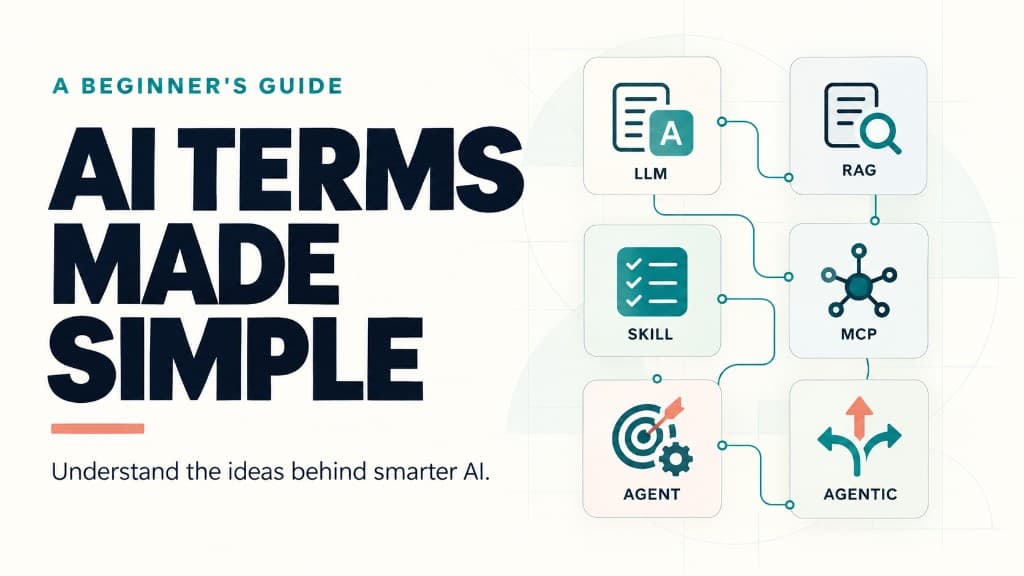
Same request. Very different behaviour. The gap comes down to a handful of AI terms that get thrown around as if everyone already knows them: LLM, RAG, skill, MCP, agent, agentic.
This guide explains each one in plain English, using that dinner as the running example. If you want the short version first, start here.
Quick answers
- LLM: the language model that reads your request and writes the reply.
- RAG: looking up relevant information before answering.
- Skill: a reusable set of instructions for doing one kind of task well.
- MCP: a standard way for AI apps to connect to outside tools and data.
- Agent: an AI system that picks its own steps to reach a goal.
- Agentic: how independently that system acts.
1. What is an LLM? The language engine
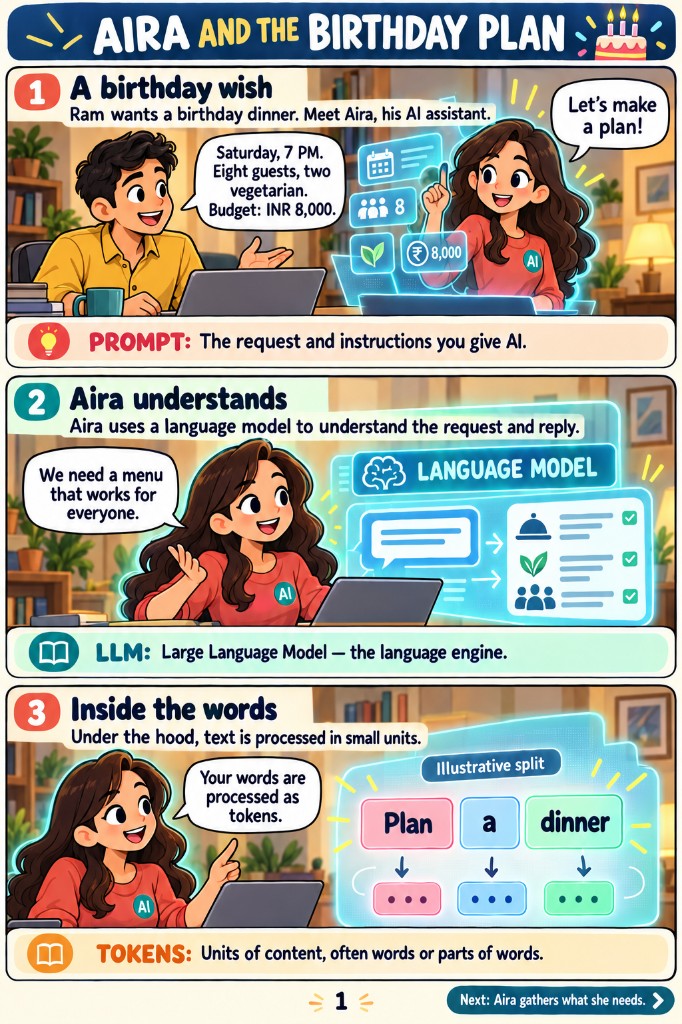
An LLM (Large Language Model) is an AI model trained on large amounts of text to learn patterns in language. It uses those patterns to understand a request and generate a response: explaining, drafting, summarising or suggesting.
Think of a very well-read assistant. Ask for a dinner plan and it can write you a sensible one.
Birthday dinner example: an LLM might suggest, "Choose a restaurant with vegetarian options, shareable dishes, and a per-person cost within your budget." Good advice. But on its own it doesn't know today's menu prices or whether a table is free on Saturday. That information has to be supplied in the conversation or fetched from somewhere.
Remember it as: the engine that works with language.
2. What is RAG? Look it up, then answer
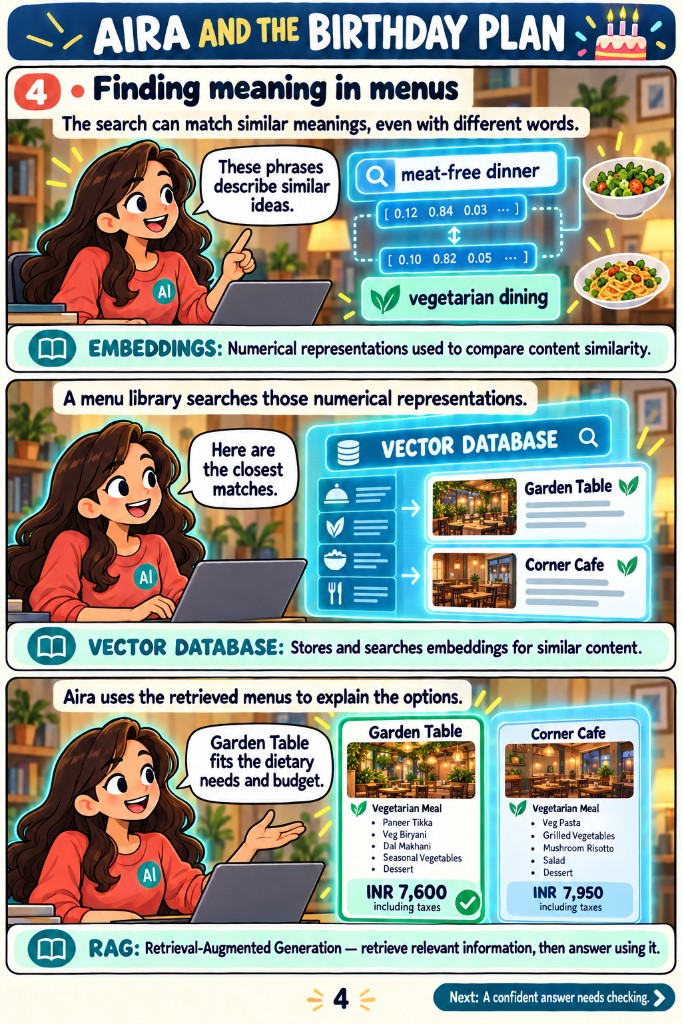
RAG (Retrieval-Augmented Generation) is a technique that finds relevant information first, then gives it to the language model so the answer is built from that material instead of from memory alone.
Picture asking a friend what a restaurant serves. A good friend opens the menu, checks, then replies. That's RAG.
Birthday dinner example: a RAG system pulls the menus of three restaurants, then explains which dishes fit your budget and the two vegetarian guests.
The process has three steps:
- Find relevant information.
- Hand it to the model.
- Generate the answer using it.
One caution. RAG can ground answers in real sources, but it doesn't guarantee they're right. The retrieved page might be outdated, incomplete or misread. IBM's explanation of RAG covers the mechanics in more depth.
Remember it as: look it up, then answer.
3. What is an AI skill? A reusable instruction manual
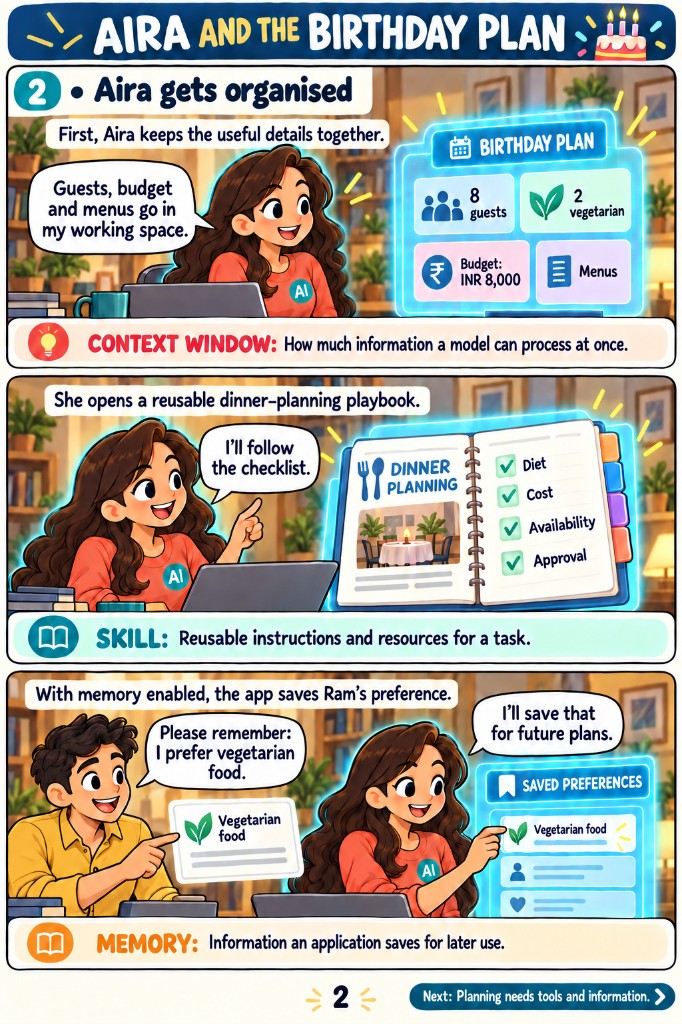
In AI assistants, a skill is a package of instructions and resources for performing a particular task. It can include templates, reference material and scripts. It doesn't retrain the model; it gives the assistant a playbook to follow when the task comes up.
Think of the event-planning handbook at a restaurant: how to collect guest preferences, work out quantities, prepare a booking checklist.
Birthday dinner example: a dinner-planning skill could tell your assistant to:
- Check dietary requirements first.
- Calculate the total cost, including taxes.
- Compare suitable venues.
- Present one clear recommendation.
See the Agent Skills overview for how skills are structured.
Remember it as: the playbook for doing a task well.
4. What is MCP? A standard way to connect AI to other systems
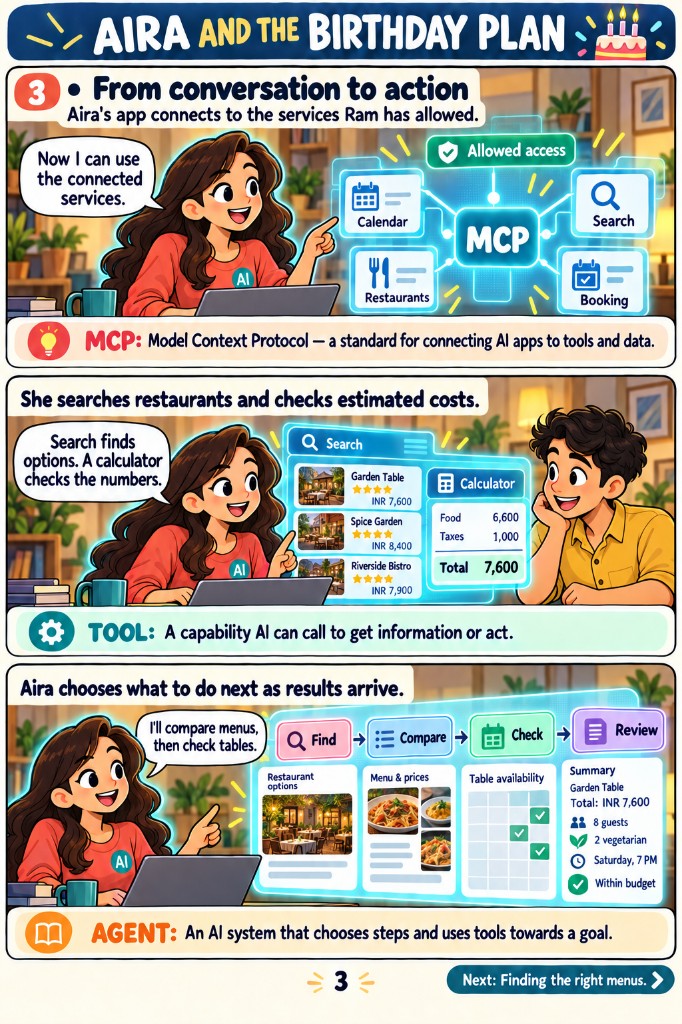
MCP (Model Context Protocol) is an open standard that lets AI applications connect to external tools and information sources in an agreed format.
Think of a universal connector. Different systems can plug in without custom wiring for each one.
Birthday dinner example: through MCP connections, an AI app could read your calendar, search restaurant information, or call a booking tool, if those have been set up and you've permitted access.
MCP is the connection standard. The connected service supplies the actual capability. Read the official MCP introduction for the details.
Remember it as: a common way for AI apps and outside systems to connect.
5. What is an AI agent? The system that carries out the task
An AI agent is a system that can choose its own steps, use tools, and react to results while working toward a goal.
Picture a personal assistant organising your dinner. It would:
- Search for suitable restaurants.
- Check menus and prices.
- Compare availability.
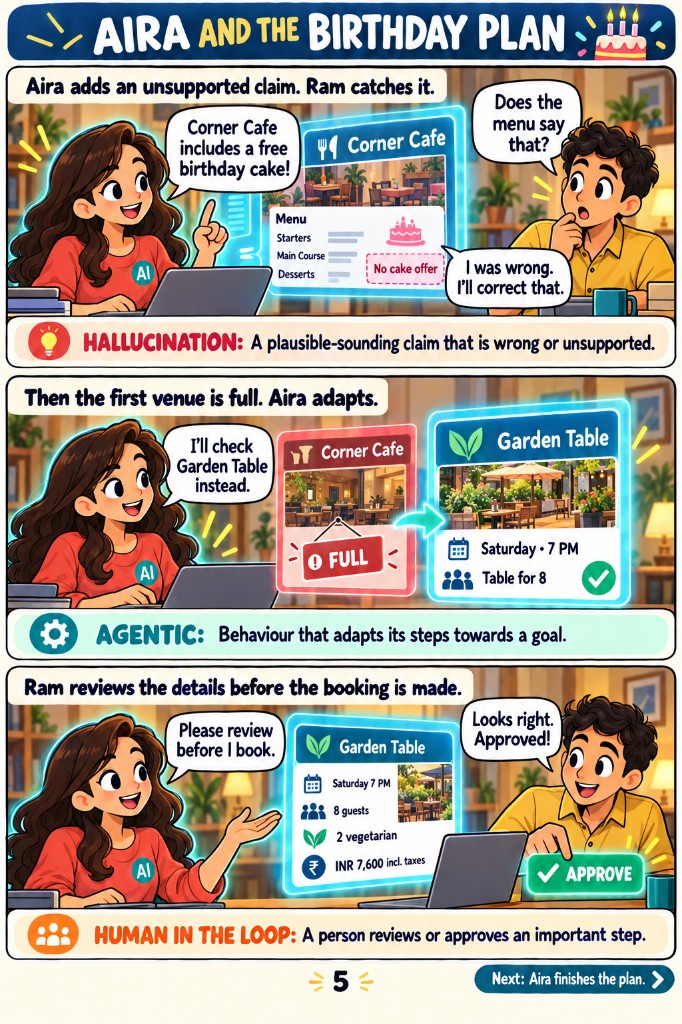
- Try another restaurant if the first is full.
- Prepare a reservation for your approval.
Step 4 is the telling one. Nobody scripted "if full, try the next." The agent decided that based on what it found, within the limits of its tools and permissions.
Definitions vary between products, but that ability to direct its own next move is the useful dividing line. Anthropic's guide to building effective agents draws the same distinction.
Remember it as: the system carrying out the task.
6. What does "agentic" mean? How independently a system works
Agentic describes behaviour in which an AI system takes initiative, chooses actions and adjusts its approach toward a goal. An agent is the system. Agentic is the adjective for how it behaves.
Compare two requests:
"Suggest three restaurants." This is mostly question and answer.
"Find a suitable restaurant, check availability, and prepare a reservation." This calls for agentic behaviour.
Agentic isn't all-or-nothing. A system might choose its own search steps but still need your approval before it books anything. Because the word gets used loosely, ask what decisions and actions a given product can actually take. The same Anthropic guide is a good reference.
Remember it as: how independently the system works toward your goal.
More AI terms worth knowing
These concepts sit around the six above and show up constantly in AI product pages.
| Term | Simple meaning | Birthday dinner example |
|---|---|---|
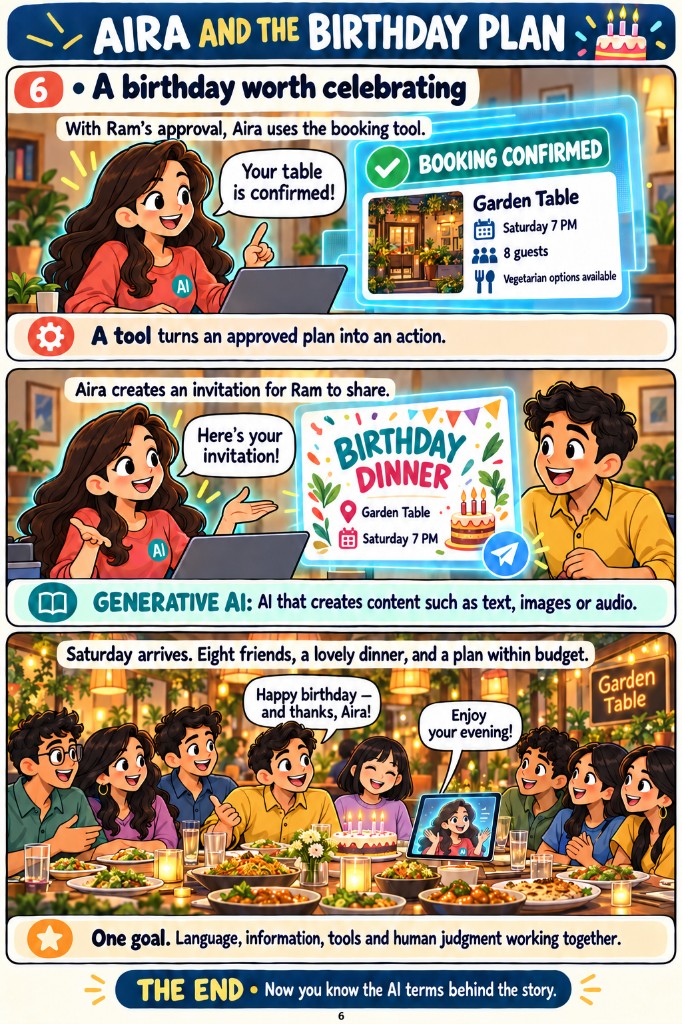
| Generative AI | AI that creates content such as text, images or audio. | Writing your invitation or making a birthday graphic. |
| Prompt | The request or instructions you give the AI. | "Plan a dinner for eight people within ₹8,000." |
| Context window | How much information a model can work with in one request. | Your instructions, guest preferences, chat history and retrieved menus all have to fit. |
| Token | A unit of content a model processes; in text, often a word or part of one. | Your request and the reply are both counted in tokens. |
| Tool | A capability the system can call to get information or take an action. | Searching restaurants, calculating costs, checking a calendar. |
| Memory | Information an app saves for later use. | Remembering that you prefer vegetarian restaurants, if that feature is on. |
| Hallucination | A confident-sounding claim that is wrong or unsupported. | Inventing a restaurant discount that doesn't exist. |
| Human in the loop | A person reviews or approves an important step. | You approve the restaurant and price before anything is booked. |
Two more terms come up whenever people discuss how AI finds information:
Embeddings turn content into lists of numbers so a system can compare meaning. They let a search connect "meat-free dinner" with "vegetarian dining" even though the words differ.
A vector database stores and searches those numbers. It's a common part of RAG systems, though RAG can use other search methods too.
RAG vs skill vs MCP: why people mix them up
All three make an assistant more useful, which is why they blur together. They answer different questions.
| Concept | The question it answers | Dinner example |
|---|---|---|
| RAG | "What information should I check before answering?" | Pull the restaurants' menus. |
| Skill | "What procedure should I follow for this task?" | Use the dinner-planning checklist. |
| MCP | "How does this app connect to outside tools and sources?" | Reach the calendar and booking service. |
They can work together. An assistant might follow a planning skill, connect to your documents through MCP, and use RAG to pull the relevant parts of them. But they're separate building blocks, and a system doesn't need all three for every task.
How the pieces work together
Back to the original request:
"Organise a birthday dinner for eight people this Saturday."
- The LLM interprets your request and writes the language.
- A skill guides the planning process.
- RAG supplies the relevant menu information.
- MCP connects the app to the services it can use.
- The agent chooses and carries out the steps. Its ability to adapt those steps is agentic behaviour.
You stay involved at the points that need your judgment or approval.
The next time an AI product throws these terms at you, ask four questions. What information can it access? What tools can it use? What decisions can it make? And when does it need me?
Frequently asked questions
What is the difference between an LLM and an AI agent?
An LLM is the language model that understands and generates text. An AI agent is a larger system that uses an LLM, plus tools and permissions, to choose steps and work toward a goal. The LLM is the engine; the agent is the whole vehicle.
What is the difference between RAG and MCP?
RAG is a technique for retrieving relevant information before the model answers. MCP is a standard for connecting AI applications to external tools and data sources. A system can use MCP to reach a document store and RAG to pull the right passages from it.
Is an AI skill the same as a tool?
No. A skill is a set of instructions and resources describing how to do a task. A tool is a capability the system can call, like a search or a calculator. A skill may tell the assistant when to use which tool.
What does "agentic AI" mean in simple terms?
Agentic AI is AI that takes initiative: it chooses actions, reacts to results and adjusts its approach toward a goal, instead of only answering one question at a time. How much freedom it has varies by product.
Can RAG stop an AI from hallucinating?
It can reduce the problem by grounding answers in retrieved sources, but it can't eliminate it. The retrieved information may be outdated or incomplete, and the model can still misread it.
Do I need RAG, skills and MCP together?
No. They're separate building blocks. Many useful systems use only one or two of them.